Key points
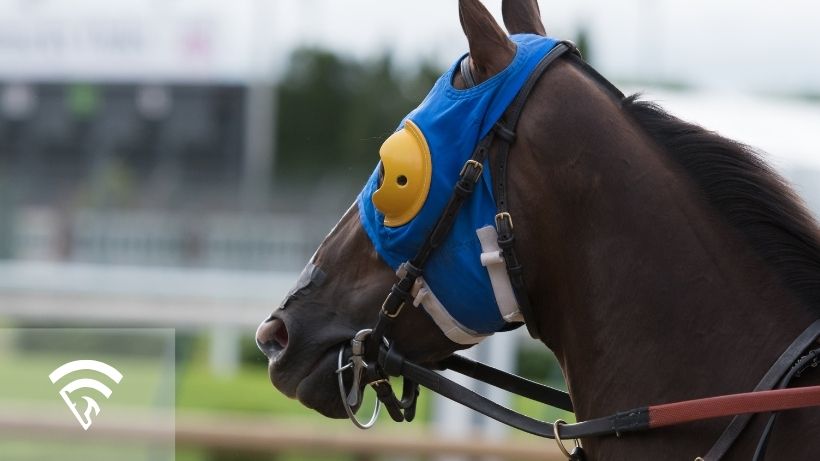
- Blinkers are racehorse headgear with eye cups that limit side and rear vision.
- Trainers use blinkers to help a horse focus forward and reduce distractions during a race.
- “Blinkers on” can signal a trainer wants sharper focus, straighter running, or more early speed.
- “Blinkers off” can signal a trainer wants the horse to relax, settle, or finish more comfortably.
- Blinkers can affect performance, but they are one handicapping clue, not a stand-alone betting angle.
- Bettors usually find blinkers changes in past performances, racing programs, and equipment-change notes.
Quick definition: blinkers
Blinkers in horse racing are a type of racehorse headgear with cups near the horse’s eyes that limit peripheral and rear vision. They are designed to help a horse focus forward, reduce distractions, and run more directly during a race.
Blinkers are also called blinders, blinds, or winkers in some racing contexts. The exact terminology can vary by region, but the core idea is the same: the equipment changes what the horse can see.
For handicappers, blinkers matter because they often appear as an equipment change in past performances or racing programs. A horse adding blinkers or removing blinkers may behave differently than it did in recent races.
What are blinkers used for in horse racing?
Blinkers are used to manage a horse’s field of vision. Racehorses naturally have wide peripheral vision, which helps them see movement beside and behind them. That awareness can be useful, but during a race it can also create distractions.
A horse may notice another horse moving up outside, the crowd, shadows, track objects, or activity near the rail. Some horses react by drifting, shying away, losing focus, or waiting on other horses instead of finishing their run.
Blinkers can help by narrowing the horse’s visual field. With less side and rear vision, the horse may pay more attention to what is directly ahead: the track, the rider’s cues, and the forward task of running.
Trainers may add blinkers to encourage:
- Better focus during a race
- Straighter running through the stretch
- More early speed from the gate
- Less shying from other horses or objects
- A more aggressive or engaged racing style
- Fewer distractions when surrounded by traffic
That does not mean blinkers automatically improve a horse. Some horses respond well. Others do not. The value for a handicapper comes from understanding what the trainer may be trying to change.
What does “blinkers on” mean?
“Blinkers on” means a horse is racing with blinkers after not wearing them in its most recent start, or after a period without them. In past performances, this is usually shown as an equipment change.
From a handicapping perspective, blinkers on can suggest the trainer wants the horse to focus more sharply or show more tactical speed. This is especially relevant if the horse has been breaking slowly, losing position early, drifting in the stretch, or appearing unfocused in recent running lines.
For example, a horse that has been closing mildly but never engaging early may add blinkers to become more involved from the start. Another horse that has been drifting outward in the stretch may add blinkers to help it stay straighter.
Common reasons for blinkers on include:
- The horse has been distracted in prior races.
- The horse has not shown enough early interest.
- The horse has been drifting or running greenly.
- The trainer wants a more forward running style.
- The horse is young or inexperienced and still learning.
Blinkers on is worth noticing, but it should not be treated as a magic upgrade. It is a signal to investigate, not a reason by itself to bet.
What does “blinkers off” mean?
“Blinkers off” means a horse is racing without blinkers after wearing them previously. Trainers may remove blinkers when they believe the equipment is making a horse too sharp, too aggressive, or too difficult to settle.
Some horses become overly keen with blinkers. They may rush early, fight the jockey, or use too much energy before the real running begins. Removing blinkers can help those horses relax, see more of what is around them, and settle into a better rhythm.
Blinkers off can be especially interesting when a horse has shown speed but faded late. The equipment change may suggest the trainer wants the horse to conserve energy instead of forcing the pace.
Common reasons for blinkers off include:
- The horse has been too aggressive early.
- The horse needs to relax and settle.
- The horse has been tiring after showing speed.
- The trainer wants a more patient ride.
- The horse did not improve with blinkers on.
As with blinkers on, blinkers off should be read in context. The change may help, hurt, or make little difference.
Where do bettors see blinkers changes?
Bettors usually see blinkers information in a racing program, past performances, or equipment-change notes. Depending on the source, the notation may show that blinkers are being added, removed, or worn again.
This matters because equipment changes can help explain why a horse may run differently from its recent form. If a horse has been slow from the gate and now adds blinkers, that may affect pace projections. If a horse has been speed-and-fade with blinkers and now removes them, that may affect how you view its ability to finish.
In EquinEdge, equipment context works best when it is considered alongside the broader handicapping picture, including past performance data, Pace Metric, EE Win Percentage, jockey and trainer stats, and race setup.
Handicapper interpretation: what blinkers can and cannot tell you
Blinkers are useful because they give you a clue about trainer intent. They can suggest that a horse’s connections are trying to solve a specific racing problem.
Blinkers can suggest:
- A trainer wants the horse more focused.
- A horse may show more early speed.
- A horse may run straighter or avoid distractions.
- A previous race may not reflect the trainer’s ideal setup.
- The barn is experimenting with equipment to unlock improvement.
Blinkers cannot prove:
- The horse will improve today.
- The horse will break faster.
- The horse will handle the distance.
- The horse is fit enough to win.
- The horse offers betting value.
Before upgrading or downgrading a horse because of blinkers, check the supporting evidence. Look at recent running lines, early pace, class level, distance changes, jockey and trainer patterns, workouts, and whether the horse has worn blinkers before.
A first-time blinkers move from a high-percentage trainer may carry more weight than the same move from a barn with limited success using equipment changes. A blinkers-off change after repeated pace collapses may be more meaningful if today’s race shape favors a calmer trip.
Types of blinkers and related horse headgear
Horse racing blinkers are part of a broader category of horse headgear used to manage vision, attention, and behavior. The names can overlap, but these terms generally refer to equipment variations that affect what the horse can see.
Blinkers: The common racing term for headgear with eye cups that limit side and rear vision.
Blinders: Often used interchangeably with blinkers. In many contexts, horse blinders or blinkers refer to the same basic concept.
Visors: A type of headgear that may allow slightly more vision than full blinkers while still helping direct focus forward.
Semi-cups: Blinkers with a less restrictive cup design. They reduce vision less than full cups and may be used when a trainer wants some focus without completely narrowing the horse’s view.
Cheek pieces: Equipment placed along the side of the horse’s face to influence field of vision and attention. They are generally less enclosing than full blinkers.
The exact equipment and rules can vary by racing jurisdiction, but for handicapping purposes, the key question is simple: is the trainer changing how much the horse can see, and why might that matter today?
Example: how blinkers might affect a race read
Imagine a horse has finished fourth, fifth, and fourth in its last three starts. In each race, it broke slowly, trailed early, and made a mild late move without threatening the winner. Today, the horse adds blinkers.
That change may suggest the trainer wants more early engagement. If the horse also has a sharp recent workout, a positive jockey switch, and a race shape where early position matters, blinkers on becomes a meaningful part of the case.
But if the same horse is stretching out in distance, facing tougher company, and has never shown enough speed to stay close, blinkers alone should not outweigh the rest of the data.
The better question is not, “Are blinkers good or bad?” The better question is, “What problem might this change be trying to solve, and does the rest of the evidence support it?”
How to use blinkers in your handicapping
Treat blinkers as one input in your race analysis. They are most useful when they connect to something visible in the horse’s prior form.
A practical process:
- Check whether the change is blinkers on or blinkers off.
- Review the horse’s recent running lines for clues.
- Look for signs of distraction, drifting, slow starts, or early over-aggression.
- Compare the change with today’s race shape and pace scenario.
- Review trainer and jockey context.
- Decide whether the equipment change supports or weakens the horse’s overall profile.
For a deeper betting-focused breakdown, see EquinEdge’s guide to handicapping with blinkers on or off.
FAQ: blinkers in horse racing
Why do horses wear blinkers in racing?
Horses wear blinkers to limit side and rear vision so they can focus more on what is ahead of them. Trainers may use blinkers to reduce distractions, encourage early speed, help a horse run straighter, or prevent shying from other horses or objects.
Do blinkers make a horse run faster?
Blinkers do not automatically make a horse faster. They may help a horse focus or use its speed more effectively, but the result depends on the individual horse, trainer intent, race setup, and overall form.
What is the difference between blinkers and blinders?
In horse racing, blinkers and blinders are often used to mean the same thing: headgear that limits a horse’s field of vision. “Blinkers” is the more common racing term in many past performances and programs.
What does blinkers on mean in horse racing?
Blinkers on means the horse is adding blinkers for the race. This may signal that the trainer wants the horse to focus better, show more early speed, or avoid distractions.
What does blinkers off mean in horse racing?
Blinkers off means the horse is removing blinkers after previously wearing them. Trainers may do this to help a horse relax, settle into rhythm, or avoid using too much energy early.
Do some horses dislike blinkers?
Yes. Some horses do not respond well to blinkers. A horse may become too aggressive, uncomfortable, or less relaxed with restricted vision. That is one reason trainers may experiment with blinkers on or blinkers off over time.
Bottom line
Blinkers in horse racing are headgear designed to limit a horse’s side and rear vision, helping the horse focus forward and reduce distractions. For bettors, blinkers are most useful as an equipment-change clue.
Blinkers on may point to a trainer looking for sharper focus or more early speed. Blinkers off may suggest the trainer wants the horse to relax and finish better. Either way, the change should be weighed alongside pace, form, trainer patterns, jockey context, and past performance data before it influences a bet.