Key points
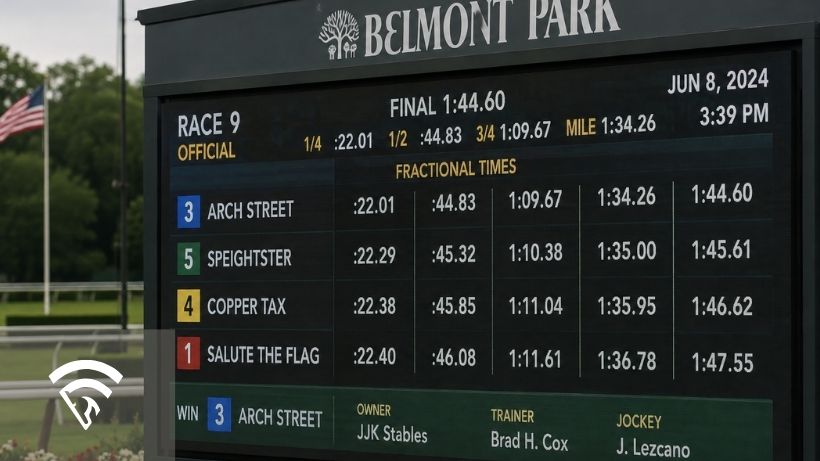
- Fractional time measures the total elapsed time from the starting gate to a specific point of call on the track.
- Split time measures the exact duration a horse takes to run between two individual points of call.
- Past performance charts record fractional times at fixed distance markers like the quarter mile and half mile.
- Subtracting the previous fractional time from the current fractional time reveals the split time for that segment.
- Fast early split times tire front runners and help late closing horses win near the finish line.
- Modern handicapping tools convert raw split times into standardized pace ratings to account for track speed variations.
Defining Fractional Time vs. Split Time
Fractional time and split time are two ways to measure horse racing speed across different sections of a race track. While both numbers come from the same official timing equipment, they serve different functions for handicappers analyzing a race.
Fractional time is the cumulative elapsed time from the start gate to a specific marker on the track, known as a point of call. When the leader crosses the first quarter mile, the timer displays the total time passed since the gate opened. If the clock reads 22.40 seconds at the quarter-mile mark and 45.60 seconds at the half-mile mark, those two numbers are the fractional times for those distances.
Split time is the duration a horse takes to complete one specific segment between two points of call. Instead of measuring total time from the start, a split time resets at each marker to isolate individual segments. In that same race, the horse ran the second quarter mile in 23.20 seconds. That 23.20 seconds is the split time for the second segment.
Understanding this difference allows you to judge whether a horse ran evenly, sped up, or slowed down as the race progressed.
Points of Call in Horse Racing
Official timing systems record fractional times at predetermined distance markers along the track. These markers are called points of call, and they vary depending on the total distance of the race.
In American thoroughbred racing, tracks measure race distances in furlongs. One furlong equals one-eighth of a mile, or 220 yards. The standard points of call include:
- The 1/4 mile call: Located at 2 furlongs (440 yards) from the start.
- The 1/2 mile call: Located at 4 furlongs (880 yards) from the start.
- The 3/4 mile call: Located at 6 furlongs (1,320 yards) from the start.
- The 1 mile call: Located at 8 furlongs (1,760 yards) from the start.
- The stretch call: Located at the final turn, usually one furlong (220 yards) before the finish line.
- The final time: The total time recorded as the winner crosses the finish line.
Short races, such as a quarter-mile sprint race, rely on fewer points of call because the entire race ends in under 25 seconds. Longer route races use three or four points of call before horses reach the stretch run.
How to Calculate Split Times From Fractional Times
Past performance programs usually display cumulative fractional times for the race leader rather than individual segment splits. To calculate the split times yourself, subtract the earlier fractional time from the later fractional time.
Here is a breakdown of a standard 1-mile (8-furlong) dirt race:
| Distance / Point of Call | Fractional Time (Cumulative) | Calculation | Split Time (Segment) |
|---|---|---|---|
| 1/4 Mile (2 Furlongs) | 22.40 seconds | Start to 1/4 Mile | 22.40 seconds |
| 1/2 Mile (4 Furlongs) | 45.60 seconds | 45.60 minus 22.40 | 23.20 seconds |
| 3/4 Mile (6 Furlongs) | 1:10.20 (70.20 seconds) | 70.20 minus 45.60 | 24.60 seconds |
| 1 Mile (8 Furlongs) | 1:36.00 (96.00 seconds) | 96.00 minus 70.20 | 25.80 seconds |
In this example, the leader ran the opening quarter mile in 22.40 seconds. The second quarter mile took 23.20 seconds. The third quarter mile took 24.60 seconds, and the final quarter mile took 25.80 seconds.
Notice how each split time grows longer as the race goes on. Horses naturally slow down over longer distances due to fatigue. A horse that runs a final split time close to its early split times shows exceptional stamina.
Benchmark Fractional Times by Distance
Fractional times change based on race surface, track condition, and class level. However, standard benchmarks help handicappers instantly identify fast, average, or slow pace scenarios on dirt tracks.
6-Furlong Sprint Benchmarks
- Fast opening 1/4 mile: Under 22.00 seconds
- Average opening 1/4 mile: 22.20 to 22.60 seconds
- Slow opening 1/4 mile: Over 23.00 seconds
- Fast 1/2 mile fraction: Under 45.00 seconds
- Average 1/2 mile fraction: 45.20 to 46.00 seconds
1-Mile Route Benchmarks
- Fast opening 1/4 mile: Under 23.00 seconds
- Average opening 1/4 mile: 23.20 to 23.80 seconds
- Slow opening 1/4 mile: Over 24.00 seconds
- Fast 1/2 mile fraction: Under 46.50 seconds
- Average 1/2 mile fraction: 47.00 to 48.00 seconds
Turf races usually produce slower early fractional times than dirt races, but turf horses often run faster closing split times in the final quarter mile.
Using Split Times for Pace Handicapping
Pace handicapping centers on how fast horses run during the early stages of a race compared to the late stages. Analyzing split times helps you predict which horses will control the lead and which horses will finish strong.
When horses set an extremely fast early split time, they consume their energy stores quickly. This scenario, called a hot pace, causes early leaders to tire in the stretch. Closers benefit from a hot pace because they save energy during the fast opening fractions and pass tired front runners near the finish.
Conversely, when the early split times are slow, the front runner conserves energy. A leader riding a slow pace can accelerate in the final stretch, making it nearly impossible for off-the-pace horses to catch up.
To simplify pace analysis across different tracks, handicappers assign a pace figure calculation to each segment. This numerical rating converts raw split times into a standardized scale that accounts for surface speed differences. Applying structured pace handicapping techniques helps you identify horses that run well under specific race flows.
Comparing early speed versus late speed figures shows whether a horse prefers setting the tempo or waiting for late momentum. Matching these traits against each contender reveals every horse win type profile in the field.
Frequently Asked Questions About Fractional and Split Times
What is the difference between fractional time and split time?
Fractional time measures total time from the start gate to a specific point on the track. Split time measures the exact duration taken to run a single segment between two points.
Where can I find fractional times in past performances?
Equibase charts and Daily Racing Form past performances list fractional times near the top of each race entry. They display the leader's cumulative times at each official point of call.
What is a closing fraction?
A closing fraction is the split time for the final segment of a race, usually the last quarter mile or final furlong. A fast closing fraction indicates that a horse finished with strong energy.
How do track conditions affect split times?
Sloppy or heavy tracks slow down early split times because horses lose traction. Dry, fast dirt tracks produce faster early fractions and quicker overall times.
Analyze Pace Data with EquinEdge
Calculating individual split times by hand takes time when evaluating a full race card. EquinEdge automates this process by processing live track data, historical split times, and pace metrics for every horse in North America. Explore EquinEdge tools today to sharpen your race analysis with instant pace predictions.