Key points
- A two-turn race sends horses around two bends before they reach the finish.
- Track configuration, not distance alone, determines whether a race has one turn or two.
- Most two-turn races are routes that test stamina, pace control, and tactical position.
- A starting chute can turn the same listed distance into a one-turn race at another track.
- Handicappers should compare past performances by surface, distance, pace, and turn configuration.
- Horses that handle the first turn well often save ground and avoid early trouble.
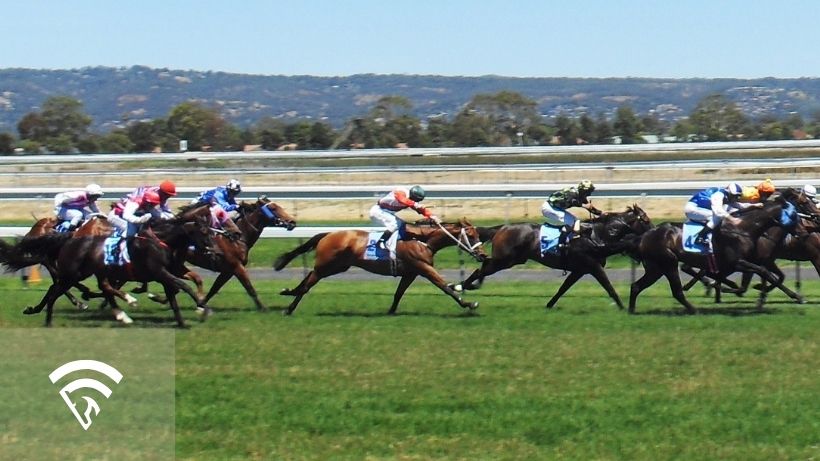
A two-turn race is a horse race in which horses navigate two turns of the racetrack before reaching the finish line. In North American Thoroughbred racing, these races usually take place at route distances, often one mile or longer, on an oval track.
The term sounds simple, but handicappers should not assume that every mile race is a two-turn race. A track’s layout, the location of its starting chute, and the listed distance all affect the race configuration.
That difference matters because turns shape the pace, the trip, the ground each horse covers, and the type of runner that may perform best.
How does a two-turn race work?
Most traditional dirt and turf tracks use an oval layout with two major bends. In a two-turn race, horses start on the oval or enter it quickly, then run around both turns before the finish.
A two-turn race may begin near the clubhouse turn, on the backstretch, or from another point on the track. The exact starting point depends on the track and race distance.
For example, a 1 1/16-mile race at a typical oval track usually sends horses through both turns. The field must establish position early, settle into a pace pattern down the backstretch, negotiate the far turn, and make its final move into the stretch.
The first turn often creates the earliest tactical decision. Horses with inside posts may save ground, while horses drawn outside may need speed to avoid losing position or covering extra distance.
Is every one-mile race a two-turn race?
No. A one-mile race can be either a one-turn race or a two-turn race.
Some tracks use a long straight starting chute for mile races. That setup allows horses to run one long turn before the stretch. Other tracks start mile races on the oval, which requires horses to navigate two turns.
This is why the listed distance alone does not tell you the full story.
A mile at Belmont Park, for example, has historically been known as a one-turn mile because of its long chute and wide layout. A mile at many smaller or more traditional oval tracks is a two-turn race.
When comparing races, check the track configuration before treating a horse’s one-mile form as directly comparable.
Why do two-turn races matter to handicappers?
Two-turn races place different demands on horses than one-turn races and short sprints. A horse needs enough early speed to secure a workable position, enough tactical ability to handle the turns, and enough stamina to finish after a longer sustained run.
Here are the main factors to consider.
Pace can develop differently
One-turn races often produce faster early fractions because horses have a longer straight run before the turn. In a two-turn race, jockeys may try to conserve energy before the first turn and down the backstretch.
That does not mean every two-turn race has a slow pace. A field with several front-runners can still create a fast and contested early pace. It means the track layout changes how riders use speed and when horses begin their moves.
Review fractional times and pace instead of comparing raw early fractions across different configurations.
Position into the first turn matters
The run to the first turn can create trouble, especially when a race starts close to the bend. Horses drawn outside may need to use extra speed to avoid getting caught wide.
Inside posts can offer an advantage if a horse breaks sharply and holds position. An inside runner that breaks slowly can get shuffled back behind tiring rivals.
A horse’s running style can help you judge this risk. Front-runners and pressers may gain an edge when they can secure the rail or a clear stalking spot. Deep closers may need a fair pace and a clean path around traffic.
Ground loss adds up
A horse that races wide around both turns travels farther than a horse that saves ground near the rail. The added distance may not show clearly in a final speed figure or finishing position.
This is where trip handicapping helps. A horse may have run better than its result suggests if it raced wide on both turns, encountered traffic, or lost position entering the far turn. Understanding a horse’s trip can reveal contenders that the public overlooks next time.
Stamina becomes more important
Two-turn races commonly fall into the route category. Horses must carry their speed farther than they would in a sprint.
A sprinter moving into a two-turn route may show early pace but weaken after the far turn. Another horse may lack quick sprint speed but improve when it can settle, make one sustained run, and use its stamina late.
Past performances can show whether a horse has handled similar route conditions before. Focus on prior races at comparable distances, surfaces, class levels, and track configurations.
How to identify a two-turn race
Use this quick checklist before you handicap a route race:
- Confirm the track and surface. Dirt and turf courses can use different start locations and layouts.
- Check the listed distance. Eight furlongs equals one mile, but a mile may be one turn or two.
- Find the start location. A chute can create a one-turn configuration.
- Review the track diagram. Many past-performance platforms and track websites show where each race begins.
- Compare prior races carefully. A horse’s one-turn mile performance may not translate directly to a two-turn mile.
- Study pace and position. Consider which horses can reach the first turn without using too much energy.
A horse racing distance and track type guide can also help you place route distances in context.
Two-turn race example
Imagine a field of eight horses in a 1 1/16-mile dirt race at a standard oval track.
Horse A has strong early speed and draws post 2. It can break cleanly, save ground into the first turn, and control the pace.
Horse B has similar speed but draws post 8. Its rider may need to use more energy early to avoid racing wide or getting hung outside.
Horse C is a closer with proven two-turn form. It may sit behind the early speed, save ground, and make a move around the far turn if the leaders set a demanding pace.
Horse D has posted strong figures in one-turn mile races but has never raced around two turns. Its raw speed may make it competitive, but its past performances do not yet prove that it can relax, handle both bends, and finish effectively in this setup.
The two-turn configuration gives extra context to every horse’s prior form.
Related horse racing terms
- Route race: A longer race, commonly one mile or more.
- One-turn mile: A mile race that uses a chute and includes only one major bend.
- Starting chute: A straight extension of the track that gives horses more run before entering a turn.
- Turn time: The portion of a race between the early and late fractions, often called the hidden fraction.
- Final turn: The last bend before the stretch, where many horses begin their decisive move. Learn more about the final turn in horse racing.
- Pace: The speed and pressure of the race at each stage.
FAQ
What is a two-turn mile in horse racing?
A two-turn mile is a one-mile race in which horses navigate two turns before the finish. Whether a mile uses one turn or two depends on the track’s layout and starting position.
Are all route races two-turn races?
No. Many route races use two turns, but a route can use one turn when a track has a long enough chute or a different course configuration. Always check the specific track and distance.
Why are two-turn races harder for some horses?
Two-turn races ask horses to balance speed, position, turning ability, and stamina. A horse that runs well in sprints or one-turn races may struggle if it cannot settle, save ground, or sustain its run around two bends.
How should I compare one-turn and two-turn past performances?
Compare the distance, surface, pace, running style, and track layout. Give added weight to horses that have already performed well in a similar two-turn setup, especially when they faced comparable class and pace pressure.
Does post position matter more in a two-turn race?
Post position can matter because horses must establish position before or into the first turn. The impact varies by track, field size, distance, and each horse’s running style.